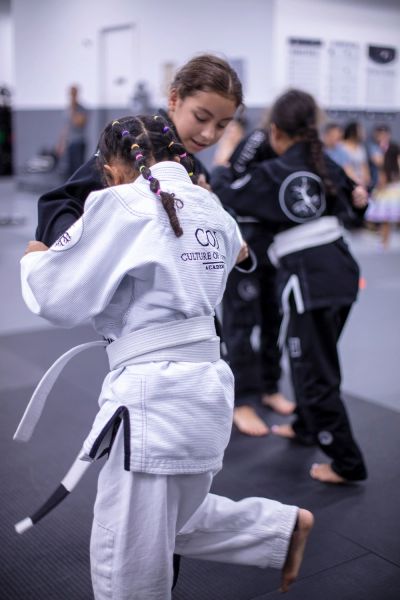
Benefits of Brazilian Jiu-Jitsu for Kids
Benefits of Brazilian Jiu-Jitsu for Kids
Brazilian Jiu-Jitsu delivers some of the most practical, transferable benefits available to children: lasting confidence, improved focus and self-discipline, real anti-bullying skills, better physical coordination, and emotional resilience, all in a structured, fun environment that works for kids of varying personalities and energy levels. At Culture of Jiu Jitsu Academy in Gaithersburg, the kids program (Baby Roots, Little Roots and Big Roots) is intentionally designed around these outcomes under experienced coaches who prioritize character alongside technique.
Parents in Gaithersburg, Montgomery County, and the DMV often seek activities that go beyond sports or screen time. They want something that builds inner strength, teaches respect, and gives children tools they can use both on the playground and later in life. Brazilian Jiu-Jitsu stands out because it combines physical challenge with mental problem-solving and social development in a single class.
Core Benefits of BJJ for Children
Brazilian Jiu-Jitsu improves confidence through earned achievement, strengthens focus and impulse control via constant problem-solving, teaches practical self-defense without striking, builds physical fitness and body awareness, and develops respect, resilience, and social skills through partner training and structured progression. These benefits appear consistently across age groups when classes are age-appropriate and coached with care.
Confidence That Comes from Real Capability
Confidence built on the mats is different from confidence based only on praise. When a child learns to escape a stronger partner's hold or successfully applies a technique they have drilled, they gain a quiet, durable belief in their own ability. Parents frequently notice this shift first, kids stand taller, speak up more, and handle setbacks with less frustration.
One pattern we see regularly at Culture of Jiu Jitsu Academy: children who start shy or hesitant often become more assertive and calm within a few months. The belt-and-stripe system gives them clear, achievable milestones that feel meaningful because they are earned through consistent effort.
Focus, Discipline, and Impulse Control
BJJ is often described as physical chess. Kids must pay attention to grips, weight distribution, and timing while managing their own energy. This kind of active focus is especially helpful for children who struggle to sit still or stay engaged in passive settings. Structured class rituals, lining up, listening to instruction, drilling with a partner, reinforce self-regulation in a way that feels natural rather than forced.
Many parents of children with attention challenges report noticeable improvements in listening at home and in school after regular training. The physical nature of the activity meets energetic kids where they are while channeling that energy productively.
Practical Anti-Bullying and Self-Defense Skills
Unlike striking arts, Brazilian Jiu-Jitsu emphasizes control and leverage. Children learn how to neutralize a larger or stronger peer without throwing punches or escalating violence. This matters on the playground and in everyday situations. The goal is not to create aggressive kids, it is to create capable, calm kids who are less likely to be targeted and better equipped to protect themselves or others if needed.
Physical Development and Body Awareness
Classes improve strength, flexibility, coordination, balance, and cardiovascular fitness through functional movement. Kids develop better spatial awareness and motor control that often carries into other sports and daily activities. Because there is no striking, the injury profile is generally favorable compared with many contact sports when training is properly supervised.
Character, Resilience, and Social Skills
Every class includes winning and losing in a controlled environment. Children practice humility after success and persistence after failure. Partner training requires communication, respect for boundaries, and cooperation. Over time these habits shape how kids treat teammates, siblings, and classmates.
How Culture of Jiu Jitsu Academy Structures Kids Training
Culture of Jiu Jitsu Academy offers dedicated kids Brazilian Jiu-Jitsu programs: Baby Roots (ages 3 to 4), Little Roots (ages 4 to 7) and Big Roots (ages 8 to 12). Classes emphasize confidence, discipline, respect, and fun alongside technical skill. The coaching team, led by Max Gimenis (IBJJF World Champion and UFC fighter) and Eric Philcox, maintains high technical standards while keeping the environment welcoming for beginners.
The academy also runs seasonal kids camps that combine Jiu-Jitsu, self-defense, games, arts and crafts, and teamwork. These camps help maintain progress during school breaks and give children an immersive, positive experience.
A free 7-Day Trial allows families to experience the classes, coaching style, and culture with no long-term commitment.
How BJJ Compares with Other Kids Activities
Brazilian Jiu-Jitsu stands out for combining physical skill, mental challenge, and character development in one format, though it carries a steeper early technical learning curve. Traditional Karate or Taekwondo builds discipline through kicking and striking forms but places less emphasis on ground control and live resistance. Team sports like soccer or basketball build teamwork and conditioning but offer less individual skill ownership and more variable exposure to bullying. Gymnastics or dance develop flexibility and body control but offer limited self-defense or conflict-resolution skills. Screen-based or passive activities are convenient but provide minimal physical or social development. Across all of these, BJJ rates highest for confidence and character focus.
What Parents Commonly Notice After a Few Months
Parents commonly report improved listening and the ability to follow multi-step instructions, greater willingness to try difficult things without immediate frustration, better body language and reduced targeting by peers, stronger friendships formed through mutual respect on the mats, and noticeable gains in coordination and overall fitness.
One coaching observation we share often: the kids who progress most steadily are those whose parents treat training as a long-term habit rather than a short-term fix. Consistency of two to three classes per week produces the clearest results.
Safety Considerations for Kids in Brazilian Jiu-Jitsu
Brazilian Jiu-Jitsu is among the safer martial arts for children because it contains no striking. Injury rates in properly supervised kids classes are generally lower than many popular youth sports. Common issues, when they occur, tend to be minor strains, mat burns, or sore muscles. Responsible academies prohibit dangerous techniques for young students, emphasize early tapping, and match partners by size and experience.
Parents should look for clean facilities, attentive coaches, age-separated classes, and a culture that prioritizes long-term student development over aggressive competition for young children.